n DIGESTIVE
SYSTEM
n In
simple terms, the digestive system is a portal for nutrients to gain access to
the circulatory system.
► Foodstuffs
are broken down to very simple molecules.
► Resulting
sugars, amino acids, fatty acids, etc. are then transported across the GI tract
lining into blood.
► The
specific foodstuffs animals are able to utilize is dependent on the type of
digestive system they possess.
n Three
(3) basic types of digestive systems:
► Monogastric
– simple stomach.
► Ruminant
(cranial fermentor) – multi-compartmented stomach.
► Hind
gut (caudal) fermentor – simple stomach, but very large and complex large
intestine
Basic Functional Anatomy of the
Digestive System
– Monogastrics
n Organs of the Digestive System
– Monogastrics
n Mouth
► Mechanical breakdown of foodstuffs by
chewing (reduces particle size, increases surface area for action of enzymes).
►
Saliva added as a lubricant and, in some species, contains amylase to
begin starch digestion.
► Esophagus
► Tube connecting the mouth to the
stomach.
n Stomach
► Enzymatic digestion of proteins
begins.
► Foodstuffs reduced to liquid form.
► Liver
► Center of metabolic activity in the
body.
► Major role in digestive process is to
provide bile salts to small intestine (needed for digestion and absorption of
fats).
n Pancreas
► Provides a potent mixture of
digestive enzymes to the small intestine to help in digestion of fats,
carbohydrates, and proteins.
► Small Intestine
► 3 sections – duodenum, jejunum, ileum
► Site of final stages of chemical
enzymatic digestion.
► Where almost all nutrients are
absorbed.
n Large Intestine
► 3 sections – cecum, colon, rectum
► Site of water absorption from G.I.
tract.
► Bacterial fermentation occurs
(production and absorption of volatile fatty acids).
P Somewhat limited in monogastrics
► Feces formed.
Specialized Organs in Poultry
n Beak
► No lips, no teeth, and no chewing.
► Crop
► Out-pocketing of the esophagus that
provides storage for consumed food.
► Foodstuffs moistened and softened
(little if any digestion).
n Proventriculus
►
Glandular
stomach where the first significant amount of digestive juices are added.
n Gizzard
► A muscular organ used to grind and
break up food.
►
May
contain grit (small stones) eaten by animal.
n Cloaca
► Common chamber into which the
digestive, urinary, and reproductive tracts open.
► When
fecal material is excreted, the cloaca folds back at the vent allowing the
rectal opening of the large intestine to push out, closing the reproductive
tract opening.
Basic Functional Anatomy of the
Digestive System
– Ruminants –
« Mouth, esophagus, liver, pancreas,
gall bladder, small intestine, and large intestine have functions similar to
monogastrics.
« Ruminants
produce prodigious quantities of saliva. Published estimates for adult cows are
in the range of 100 to 150 liters of saliva per day! Aside from its normal
lubricating qualities, saliva serves at least two very important functions in
the ruminant:
« provision of fluid for the
fermentation vat
« alkaline buffering - saliva is rich
in bicarbonate, which buffers the large quanitity of acid produced in the rumen
and is probably critical for maintainance of rumen pH.
« Stomach
« Structure and function of the stomach
is the major difference between monogastrics and ruminants.
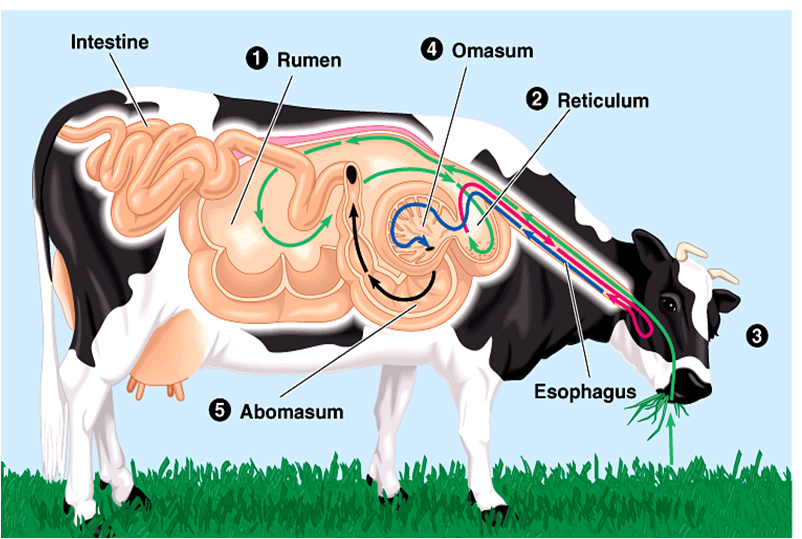
Multi-compartmented stomach – rumen, reticulum, omasum,
abomasum
n Rumen:
► Large,
anaerobic fermentation vat.
n Rumen (continued):
► Houses microorganisms.
n Protozoa
– 100,000 per gram of rumen fluid.
n Bacteria/fungi
– 100 million per gram of rumen fluid.
► Functions of microorganisms.
n Digest
roughages to make Volatile Fatty Acids (VFA’s), make
microbial protein, and make vitamins K and B-complex.
► VFA’s absorbed in rumen.
► Lined
with millions of papillae (short projections on wall of rumen) needed for
absorption.
► “Shag
carpet” appearanc
n Rumen
saturated with gases and in constant motion.
n Contractions
occur at a rate of 1-3 per minute.
► Serve
to mix contents, aid in eructation of gases, and move fluid and fermented
feedstuffs into the omasum.
n Rumination:
►
Ruminants are well known for “cud
chewing”.
► Rumination
involves:
n Bolus
of previously eaten foodstuff carried back into the mouth by reverse
peristalsis.
n Fluid
in bolus is squeezed out with the tongue and reswallowed.
n Bolus
is rechewed and reswallowed.
► Rumination
may occupy about 1/3 of a ruminant’s day
n Eructation (belching):
► Fermentation
of foodstuffs in the rumen generates enormous quantities of gas.
n 30-50
liters per hour in adult cattle.
n 5-7
liters per hour in adult sheep or goats.
► Belching
is how ruminants get rid of fermentation gases:
n Anything
that causes a hindrance to belching can be life threatening.
n Bloating
can result in death from asphyxiation.
n Reticulum:
► Contains
microorganisms (like the rumen).
► Provides
additional area for fermentation.
► As
fermentation by microorganisms proceed and feedstuffs are digested, smaller and
more dense material is pushed into the reticulum (from which it along with
microbe-laden liquid is ejected into the omasum).
► Lining
has a honeycomb structure.
n Catches
and holds hardware consumed by animal.
n Hardware
can be removed with rumen magnate.
n Omasum:
► A
heavy, hard organ with a lining that has many folds (leaves).
► Function not well understood.
► Believed
to produce a grinding action on foodstuffs.
► May
absorb residual VFA’s and bicarbonate.
n Abomasum:
► The
true, glandular stomach.
n Secretes
acids and functions very similarly to monogastric stomach.
► Unique
feature is that it secretes lysozyme.
n Enzyme
that efficiently breaks down bacterial cell walls.
n Needed
to break down the large quantities of bacteria that pass from the rumen.
n Basic Functional Anatomy of the Digestive System
– Hind Gut Fermentors –
Organs of the Digestive System




 03:45
03:45
 Unknown







 Posts
Posts

